Friday, September 16, 2011

Pulmonary Hemoptysis= Hospitalization Day # Uno

Oh, the joys of the unexpected.

Last Thursday (9/8/11) I was caring out my morning rituals as normal. Which begins by taking long list of medications, eating breakfast, getting dressed and lastly taking the dogs outside. It was a nice morning and so I decided to hang out with the dogs in the backyard to get some fresh air. During that time I had a coughing episode, which is not unusual, that produced bloody mucus. As I kept coughing and spitting. Which is highly encouraged to get the mucus up and out of the lungs, more blood than mucus started to show up. This at first was not alarming as coughing for great lengthens at a time and with great veracity can cause a few broken blood vessels. In the amount of 2 hours I had coughed up a lot of blood and began to become very concerned. Concerned enough to place a call to my doctor.

My first level of response is always to call my doctor to find out if they feel going to urgent care or the ER is necessary. Typically, a trip to either is fruitless as they really don't know how to treat such a complicated disease unless its immediately life-threatening. After a few discussions, Dr. Cohen recommended coming into his clinic to be seen.

I immediately rushed out the door to make the 45 minutes drive to his office. Upon arrival he had a preliminary diagnoses of Pulmonary Hemoptysis, which was only further confirmed after his physical evaluation. There a different levels of Pulmonary Hemoptysis, which are characterized by the amount of blood being brought up and the circumstances surrounding the current health of the patient. In my case, Dr. Cohen felt that antibiotics were necessary and since I had literally just gotten off an oral 14-day prescription of Cipro, a stay in the hospital was warranted. Ugh!

Honestly, I was not surprised. My biggest concern was that I hadn't packed anything prior to rushing out the door. You see, I have a particular set of things that always accompany me to the hospital. Books, pillow, blanket, my own pj's, sports bra (this helps when male nurses/doctors have to evaluate the lungs and with modesty), Bible and my UGG boots for walking around the halls. Nurses always get a kick out of my room, as I make it as homey as possible. I was worried about getting all this stuff. Silly, yes, but it helps ease anxieties making me comfortable when I am alone and is my saving grace during difficult times. I immediately called the hubbs to begin arranging the logistics of my stay. Hubbs works for his parents for which I am grateful. Is step-dad was able fill-in for him for the remaining part of the work day so that he could accompany during the check-in process.

B and I checked in to the hospital about 1pm. Check-in can be the worst part of the entire stay. I had to have a Picc Line placed, x-rays, blood work, etc...... I hate Picc Lines. They freak me out. I have to have to take anxiety medication for it or I cry uncontrollably during the procedure. It's really all psychological as they do a great job in numbing the area and I feel no pain. Once they have the line placed they immediately begin infusing two different anitibiotics. The first was Zosyn and the second is Tobramycin to treat Pseudomonas which are the underlying cause of the Hemoptysis.


Picc Line preparations-anyone recognize what t-shirt I am wearing?

At first dosing of each antibiotic things appeared to be going smoothly. I was a bit tired but other than that I felt pretty good. B and I decided it was safe for him to return home to get a good nights sleep and to pack me some comforts for home. My mother was going to take Friday off to be with me so that B could finish out the work week (we need the $$$, sadly). B left around 8pm to make the 1hr trek home. I fell asleep and awoke around 11pm and would not sleep again for 24hrs.

When I woke I was shivering had a fever and my body hurt. The nurses pilled on about 3 or 4 warm blankets and gave me Tylenol. The Tylenol had no affect and shortly after I began vomiting. My joints began to swell and the on-call doctor probably had no idea what to do for me. They gave me Vicodin for the pain and anti-naseau med's thru my Picc line, all in addition to my continued antibiotic regimen. The best description I can give and did give was that I felt like I was being poisoned.

The battle continued all night. All night I was shivering uncontrollably causing my muscles to ache my joints to become swollen and painful. I was sweating from the fever and I was alone! I had no comforts of home since I didn't have a chance to pack and it was in the middle of night.

Hopelessness threatened me.....

~Doodlin'

Tuesday, August 23, 2011

An Understanding

When a person is sick the first reaction of those who love the person in question is to surround them with love and support. This is a normal and very welcomed in the mist of crisis.

However, there is a fine line between getting support you need and becoming a drain on those you love. My husband would tell you that I don't ask for help enough and that I walk myself into hot water at times. I have to admit I have a lot of pride. I am the last to admit I need to go see that doctor and my dear hubby is the first! The other day he kindly remarked that he thought it was time for me to visit my doctor and my response was that I thought he needed to shut his mouth. Gasp...... I have since apologized and seen the doctor. The thing that I love about my hubby is that he notices the slightest change in me. He can detect my mood changes, which is often a reflection of fluctuations in blood sugar as well as an infection brewing. He and I have an understanding (which is not always perfect because we are imperfect) I will do as much as I can when I can and I will ask for help when I can't, he will do what he can when he can and together we'll fill in the blanks of daily life together.

The opposite is also true of some patients, they ask for too much help. I am not trying to be cold-hearted, this is a reality that is often overlooked because they are sick. I and medical professionals can tell you that if a person can do and it is deemed safe, its best that the patient does it. Being able to take care of yourself is such a freeing experience that builds confidence and usually leads to better overall health. We are people outside of our disease and we need to find a level of confidence, self-worth, and independence. Not everything is our disease. Sometimes laziness is simply that. Sometimes we find ourselves in a cycle of self-pity. We need caregivers who can recognize these whom we have an understanding with. The understanding being that we need their support at times but other times we need to be able to rely on our selves and give support in return. 

I hate the thought of causing those in my life to become burnt out on caring for me. Plus its important to me that I understand that they have difficulties in their lives as well. I hope I always retain the ability to look outside my own suffering with a gauge of perspective and know when mine is bearable and know when I should seek medical attention.

I can't say enough about my hubby. I can't even begin to spell out all the wonderful support he provides. It is not something that can really be verbalized only observed. I think anyone who has watch B and I can attest to his amazing patience, love, support, heart and overall magnificent self. He is my balance in so many ways. 

For all you endearing partners of chronically ill spouses you deserve a huge pat on the back and a giant hug. Choosing to love someone is hard enough but when you love us when we can't always control our emotions or physical state is such an act of pure honest love. Thank you!


~Doodlin'

Friday, August 19, 2011

Helping leads to relief, relief leads peace

I am thankful for being able to do things in my life that I am passionate about. Many who know me closely know that I have a few things that strike a fire under my feet and push me to help. Besides fighting for a cure for CF I am also a crusader and deeply passionate about the tremendous suffering of children in impoverish countries like Ethiopia. Let me give you a bit of background......

In 2006 I was searching for a part-time job to help supplement our income. I have had many jobs in my little lifetime and knew from experience that I wanted to work in a non-profit that makes a difference in someones life. I began my search on Craigslist and found a job opening working at an international adoption agency. I had no idea what I was getting into but I applied and got the job.

I loved my job. I loved that I made a difference, no matter how small. I was able to ease the suffering of a handle full of children by assisting their placement into forever families. By doing so, I was able to look outside my suffering and see others. I also developed some very close relationships to wonderful people and families.

What I learned ripped my heart to shreds.

During my employment with the agency I had the amazing opportunity to travel to Ethiopia for 14 days. I wrote a daily journal about my feelings towards what I saw, heard, tasted and smelled (which was little since my sniffer doesn't work well). I traveled in March of 2009 and to this day have a difficult time reading the words I wrote. At times I feel like I made it all up. How, can the suffering be so tremendous when I have SO much, when we in the US along with other industrialized nations have SO SO SO SO much.

My friend over at scooping it up, who along with her hubby had the same opportunity to travel to Ethiopia as I, wrote is so well. The devastation in Somalia and other countries like Ethiopia is consuming. It can rip you to pieces. To be honest, it should, I should feel saddened by it, I should feel anger about it, I should feel compelled to help, I should stand up and take a stand to assist in their relief.

If for no other reason but to make your selfish soul feel better, help aid the relief. I did.

~Doodlin'

Tuesday, August 16, 2011

CF Clinic

Different hospitals and/or doctors offices that are registered CF Care Centers thru the CF Foundation host what is commonly know as CF Clinic. CF Clinic is a specified day that patients see all the necessary doctors or caregivers that are pertinent in treating CF. The most common grouping of doctors is a doctor who's speciality is CF along with a dietitian, respiratory therapists, social worker and/or counselor. Patients see all the above at different times thru out the year but every month or 3-months patients can see them all under one roof.

This can be intimidating. It's typically a much longer appointment; 1 to 3 hours, and it's a lot of information in one sitting. For me, I LOVE CF Clinic. I am a busy person and to be able to see everyone in one big swoop is super duper convenient for me. But besides the convenience factor, how awesome is it that we get to have all our doctors/nurses/therapists (caregivers) in the same place at the same time to collaborate care. Problems are typically solved or at least a game plan is developed so much faster this way. All the caregivers are on the same page about your care, since they've spoken directly to one another which also allows for a more open dialogue, versus email or by phone or worst yet by me relating the information to each one.

Today was my 3 month CF Clinic. My appointment was at 1pm. I always get nervous during the drive because even though I might feel good, the numbers from different evaluation tools don't lie and reflect a decline. I know it seems silly to think that if I feel good then the numbers should reflect that, but the truth is that we sort of become accustom to feeling a certain way after awhile, therefore, a light cough might not be noticeable to the patient as they have become complacent but the PFT's (pulmonary function test) could show that infact the lung function has dropped slightly. The entire objective of having CF Clinic at regular intervals is so that small changes can be adjusted for before things get out of hand or worst does damage for which the patient can no longer regain lost ground.

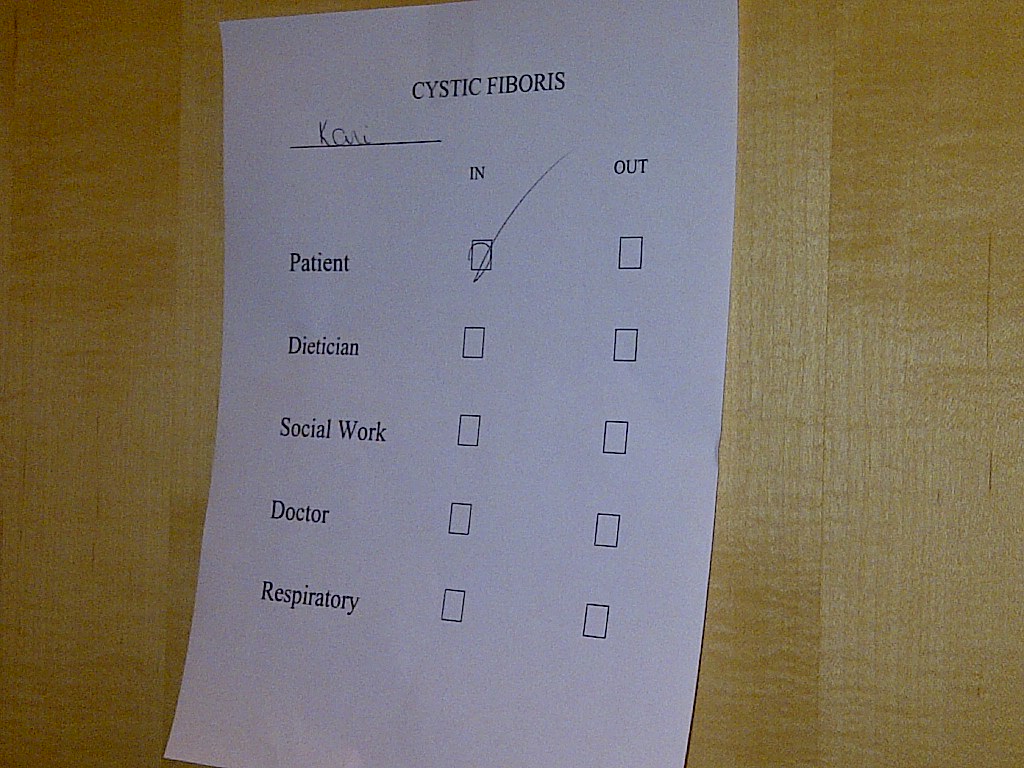
When we CFer's check in for clinic we are almost immediately taken to our examination room. The less time we spend in the lobby with sick patients the better. The logistics for how each clinic is ran varies. At  my clinic which happens to be with Kaiser Permanente in Portland, Or. each patient is assigned a room and will return to the room for the duration of the appointment. So, if I go to x-ray or the lab, I would return to the same room. This is for sterilization reasons. Here is the entrance to my room today....


As you can see, each caregiver check's off if they have seen me or not. This helps the flow as caregivers move from patient to patient. My first stop after checking into my room was with 'Respiratory'.

RESPIRATORY:
Our clinic always tries to have the patients go to respiratory first so that a base line of health can be established for this appointment. What happens is we use a device called a Spirometry that is attached by cable to a computer to measure our PFT's (pulmonary functions test) because CF is predominately a lung disease this helps the caregivers to know what sort of direction your health is going; stable, decrease, increase. For me, my PFT's have sort of leveled off or have been in the same range for a few years now. This is both good and not so good. We never want to become complacent we always want to find ways to improve the health of my lungs. Today's numbers after doing the PFT's were a bit low, which I was not 100% shocked about. I have been feeling a bit more fatigue than usual, I have a bit more of a cough when I lay flat to go to sleep and upon waking in the morning.

A little snap shot of what the device I blow in looks like for PFT's

I love the hot pink nose pinchers! Got look good when doing these sorts of tests, right?! Let me be clear these tests are not easy, you have to take a BIG BIG breathe in and release it as quickly as possible then in the same breathe continue to push as much air as you possibly can muster. For many CFer's this induces long bouts of coughing, the kind that makes your abs hurt.

The results from my PFT's are given to the physician who will be seeing next. I then go back to my assigned room (which happened to be right next door to this room).

DIETITIAN:
This is where we talk about my weight and how my feeding tube feedings are going. With the guidance of a dietitian we can make any needed adjustments. We also talk about my diabetes because that plays a significant role in my ability to gain weight. No, I am NOT on a special diabetic diet, I would look like a walking skeleton. I am on a very high caloric diet. For example; I used to do my feeding tube 5 nights a week but I have since decreased the number of nights to 3 and have maintained my weight for over six months on the 3 nights only!

SOCIAL WORKER/COUNSELOR:
This is such an important component to overall health when battling a terminal illness. We chat about all things that are going on in my life as well as how I feel I am doing in my journey with CF. I personally have and still battle with episodes of depression. In working with my social worker we have a game plan along with anti-depressents. We also talk about positive things that I can do in order to enjoy each day more. For example, sit outside for 10 minutes just taking in slow deep breathes. It's amazing how fresh air and quietness can rejuvenate a soul.

This piece I believe is fundamental.

DOCTOR:
So, the doctor is typically the last person we see. The doctor consults with everyone before seeing the patient or many times they all talk together along with me. The doctor allows me to ask any questions about any of the test results or to bring up other concerns that I feel need to be addressed. I also talk with my doctor about my diabetes because he also specializes in Endocrinology. Then my doctor and I (yes, I) talk about what we can do to facilitate the best care. I truly love that my medical team values my input. They work from a philosophy that the patient must be educated about their care, willing to carry out their care plan and able (physical, financial, etc) to carry out the care plan. If one of those pieces is missing then it won't work.

CONCLUSION:
I am on a 14 day round of Cipro for a sinus infection and we are adding another nebulizer treatment to help boost my PFT's back up. So I am taking it easy for the next 2 days or so while the Cipro works on fighting my pseudomonas and try to fit another neb treatment into my daily routine.

But because I am such a good patient and for all the times I didn't get any treats because they were chocolate I got a huge bag of my favorite bit size yummy's.


I left CF Clinic at 3:55pm! Phew. So I hope the mystery around what happens at CF Clinic is no longer such. Please ask me any question that comes to your mind, if you are thinking it I am sure others are too!

~Doodlin'

Thursday, August 11, 2011

Patient to caregiver and back again

As I grow older so do those around me and I am finding myself in quit a pickle. I have never been a caregiver. I am not a mother, I have never had to oversee care for a chronically ill parent or grandparent. I have always been the patient or the one receiving the care. My pickle is that I want to be the best caregiver I can be when and if the time arises yet I have little to no experience.

I have had some incredible caregivers. I am still lucky enough to have my mother and grandmother as two of the best caregivers in the world, if I don't say so myself! I have also had many outstanding nurses and doctors who have spend countless hours assisting.

From my perspective being a caregiver is at times is harder than being a patient. Caregivers are helpless most of the time, while the patient (if able) can make decisions about their health care to treat or ease the side affects of the illness. Caregivers are so crucial to the over-all well being of a patient, simply because of the non-medical support they provide.

In my case, my caregivers have all help in different ways, each caregiver has a different set of strengths and skills. For example, my Nana (grandmother) set of skills and strengths was to comfort. She would always come visit with yummy food that warms the insides and with a tender hug, kiss and even a lovely little song. Yes, a song! Nana would stay by my side even if I was sleeping, I can't even begin to verbalize how comforting waking up to a familiar face is in the mist of being ill. While my mom's strength was in directing traffic of sorts. She would make sure that I had what I needed when I needed it. She also dealt with the doctors, getting prescriptions, making sure I took all my medications and making sure things ran as smoothly as possible for me. She too would be there upon my waking  but often times she alot of hats to wear, like parenting my younger brother and ensuring all his needs were being met. Mom's of multiple children with whom one is ill are some of the strongest, bravest, determined and fierce woman out there, no joke.

About 4 years ago my mom was diagnosed with Thyroid cancer. The treatment was to remove the entire Thyroid and any surrounding glands if needed along with some oral medications of sorts. I had in my mind that I would walk every step of the way with her as she navigated the ruff waters. I went to a few doctors appointments and was there when she had the surgery. But I quickly realized that it is really difficult to make the transition from patient to caregiver. I have never had to care for my mom or assist her in making major medical decisions besides going for routine check-ups. I truly felt lost and had no idea how to help her or what to say to comfort her. I also think it was hard for my mom to transition from caregiver to patient. We as humans become so accustom to doing and managing things a certain way which makes change or transition difficult.

I pray I never have to become a caregiver to my mom or Nana or anyone I love but history along with time tells me that they are aging. While there is no way to anticipate the kind of care they will need or want I can begin to attempt to understand what makes a great caregiver and mentally try to become just as great a caregiver to them as they have been for me. I owe them that at the very very least.

I must learn to become a caregiver from the experiences of being a patient.

~Doodlin'


Wednesday, July 27, 2011

High-Blood-Sugar-Induced-Crankypants

It's funny, okay, not funny but seriously dangerous how many times I have to learn a lesson before the lesson learned sinks in. I have been diabetic since I was 13 yrs old so I have had enough years experience to know that I should NEVER guess my glucose (blood sugar) levels. My guess-o-meter is critically flawed compared to my fancy One Touch meter, that was made for such testing.

The other night I had a ravenous appetite and consumed a good healthy amount of snack food. Not nutritionally good food but straight-up junk, like sugary cereal. I had tested before the consumption began but thought I knew best by making the decision to not test again after the eating binge began.

About an hour later B and I were talking and apparently I had a bit of a bad attitude causing him to ask me if I was upset. This should have been trigger #1 to test my blood sugar. I either was already too far gone in my high-blood-sugar-coma or really just didn't think about it. I truly believe is was the coma. I replied to B that I wasn't upset, therefore, we began watching a regular show for the night and I fell asleep after 5-10 minutes. Upon watching up I was a bit shocked as to why I was so sleepy, trigger #2, but again did nothing.

It wasn't until I tested again before going to bed did I find out that my blood sugar was 290! That is WAY high and it probably was higher at the peak just prior to me falling asleep. My crankiness and bad attitude didn't wear off until I had my sugars back down to a safer 150.

Man am I stubborn. I am proud to say I am checking more times per day now. I hope I can stay motivated and my fingertips don't fall off.

~Doodlin'

Tuesday, July 12, 2011

A Word: Compliance

Last night while doing my nebulizer treatments I was thinking about how long it has been since my last IV (intravenous) treatment and how long it has been since my last in-patient hospitalization. I am proud to say that its been a year and a half (November 2009) since my last IV treatment and about 2.5 years (November 2008) since my last hospitalization. Astonishing!

Growing up I spent lots of time in the hospital, usually 2x a year for up to 14 days each visit. Needless to say I grew very accustom to the hospital. I had "hospital" bedding, slippers, pillows, pj's, etc that would go with me to help make the stay more comfortable. This is how you can identify someone who has spent too much time at the hospital, their hospital room looks like their room at home!

By the end of the treatments I was trying to figure out why my health has either gotten better or stabilized or was it a figment of my imagination? My conclusion is complicated but the gist of it is that I have began to understand and appreciate doing my medications.

I have been apart of so much medical advancement and have been lucky enough to be on the receiving end of the advancements. I think that one of the biggest things I have been able to do is mold my life and lifestyle around CF. While this may appear that I am letting CF control me, I am in fact doing the exact opposite. In order to have freedom from a disease you have to treat it. I have to be able to do all my medications and be able to take time out (sick days, rest days, etc) in order to enjoy my life and in order to be a productive employee.  The older I get the more I really understand and appreciate this concept. It used to be that I would put off the treatments in order to go play, go to a movie, watch tv, or whatever. But the truth is that I would feel sick, short of breath, have headache's, have low or high blood sugars that would leave me feeling depleted. When I started to reverse my priorities and take care of myself I could then really engage in whatever activity I was doing. There is a word in the medical field for all this, compliance.

Compliance is always brought up in CF Clinic. Are you being compliant with all the medications and treatments. This word compliance, is like a hammer-to-the-head, for those with a chronic illness. Seriously, I hated having to answer this question in clinic. Because, no matter how much I strive for perfection I will never be able to be 100% compliant 100% of the time. I am human, not God. I am riddled with errors. As I have found a balance, I can honestly talk about compliance in a more realistic way. I am compliant to the best of my ability and I am always looking/seeking for new ways to be more compliant. For example, doing my Vest is an area of difficulty for me because I hate sitting still for 20 minutes with literally nothing to do. The Vest, for those of you who don't know, vibrates the chest area to help the patient cough up the mucus. The vibration is really strong, so much so that I can't read during the treatment, can't hear the TV over the machine, can't really do anything that requires hand-eye coordination.  I put a commitment on Facebook about this dilemma and got lots of great ideas, like books on tape or podcast. PERFECT! Now I have solved the biggest hurdle in my compliance issue with my Vest treatments.

So, do I think my CF has gotten better, no. Has it stabilized, maybe in some ways. Do I think I have found a happy healthy balance, absolutely. I made a promise awhile ago to doing all my medications and I intend on keeping that promise but I also want to build upon that. I want to do them with a happy heart knowing that its my gateway to a smoother path rather than with dread. If you, as my readers think of fun ways to do things like The Vest or nebulizer or feeding tube treatments please let me know. We can all learn together and we can all make improvements together.

~Doodlin'
Related Posts Plugin for WordPress, Blogger...